



Winni Retails Pvt Ltd Franchise: How the Business Works and What to Expect as an Owner
What Winni Retails Pvt Ltd Is and How It Got Here
Winni Cakes & More launched in 2009 as a 100% eggless bakery targeting the substantial Indian consumer base that either avoids eggs on dietary or religious grounds or prefers eggless products for gifting occasions where recipient preferences are unknown. Starting from a single format, the brand has grown to 100 to 200 outlets across India — a network that has expanded at an average of 9.4 new units per year across 16 years of franchising, which represents consistent rather than erratic growth. Today, a Winni Retails Pvt Ltd franchise operates as a bakery-and-gifting destination: cakes are the anchor product, but the outlet also carries cupcakes, pastries, desserts, and gift items that extend the occasion range beyond birthdays and anniversaries into corporate gifting, festivals, and everyday treats. The brand’s e-commerce presence reaching 650 cities provides a demand awareness layer that physical franchise locations benefit from without having to build national marketing coverage independently.
A Franchisee’s Typical Operating Day
The bakery day starts before the store opens. A franchisee who has set up their kitchen correctly — with staff trained on the preparation schedule — arrives to a space where morning orders are already in progress: cakes ordered the previous day through the e-commerce portal or in-store, due for collection or delivery that afternoon. This advance-order visibility is one of the practical advantages of the gifting-focused bakery format over purely walk-in food formats; the franchisee knows a portion of the day’s revenue before 9 AM.
The harder part of the day begins when delivery orders from Swiggy and Zomato start arriving simultaneously with walk-in customers. Kitchen staff managing fresh preparation alongside packaging for delivery orders while the front desk handles collection requests and new inquiries is a coordination challenge that peaks on weekends and during festivals. The franchisee’s personal contribution during peak hours is not ceremonial — it is operational oversight: ensuring the kitchen is not falling behind on delivery SLAs, that order accuracy is maintained, and that walk-in customers are not waiting longer than is acceptable. Most of the franchisee’s day is spent on this operational quality control rather than on the customer-facing service that staff handles.
The Kitchen, the Menu, and the Supply Chain
Winni’s live kitchen model — where fresh baking happens at the outlet rather than through centralized production — is both a margin advantage and an operational responsibility. The brand’s proprietary recipes and food cost management protocols guide the franchisee’s production, keeping the cost structure aligned with the up-to-70-percent margin the format targets. In practice, this margin is achieved on products made in-house; finished goods ordered through the franchisor’s portal come at different cost structures and support menu breadth rather than the margin on core cake products.
In a Tier 2 city, the supply chain for raw materials — flour, dairy, flavoring agents — relies on local procurement supplemented by the franchisor’s portal for standardized components and packaging. The local sourcing reality means that the franchisee’s ability to identify reliable dairy and ingredient suppliers in their specific city matters. Quality control at the ingredient level is the franchisee’s direct responsibility, because the recipe and the preparation technique determine the product only if the raw material meets the standard the recipe assumes.
Location: What Works and What Kills the Business
Ground floor visibility on a high street is a necessary but not sufficient location condition for a Winni franchise. What actually drives revenue is proximity to the specific occasions the brand serves: residential clusters where families celebrate birthdays and anniversaries, office areas where corporate orders originate, and college areas where affordable gifting occasions are frequent. A location that is highly visible but surrounded by consumers who already have a trusted bakery relationship nearby requires significantly more time and marketing effort to build the transaction volume that justifies the investment.
Delivery logistics are the underappreciated location factor. A site with difficult access for delivery rider pickups — basement levels, congested lanes, no waiting space — accumulates delays and cancellations on aggregator platforms that damage the outlet’s platform ratings. A Winni outlet with a consistent four-star platform rating and accessible delivery pickup generates meaningfully more aggregator-driven revenue than an equivalently located outlet with a three-star rating — and the rating is built on delivery time as much as product quality.
Staff: Hiring, Training, and the Retention Problem
A Winni franchise needs three to ten staff depending on the outlet’s scale and delivery volume: typically a trained baker, a front-of-house person, and additional prep and delivery staff for larger operations. In a Tier 2 city, trained bakers with commercial kitchen experience are genuinely scarce — not unavailable, but not abundant. Winni’s 5-year kitchen staff replacement guarantee addresses this risk by providing replacement staff when trained employees leave, which is a meaningful operational guarantee in a category where staff turnover is one of the most common causes of quality degradation.
What high turnover costs in practical terms is not just the replacement effort — it is the quality inconsistency that occurs during the period between a trained baker leaving and their replacement reaching full competency. A regular customer who receives a noticeably different cake quality during this transition period may shift to a competitor before the new baker’s skills stabilize. Franchisees who invest in team retention — through stable working conditions, clear daily responsibilities, and consistent scheduling — reduce the frequency of these quality disruptions even when they cannot eliminate them entirely.
What the Franchisor Handles So You Do Not Have To
Winni Retails Pvt Ltd provides the franchisee with proprietary recipes and food cost frameworks that remove menu development from the franchisee’s responsibility. The exclusive portal for ordering packaging, raw materials, and finished goods creates a standardized procurement channel that reduces supplier relationship management effort. Training for both front-of-house and kitchen staff — including the replacement guarantee for kitchen personnel — transfers the ongoing staff capability risk partially back to the franchisor. National e-commerce presence across 650 cities generates brand awareness that precedes the franchise outlet’s opening in any given market.
What the franchisee manages independently is equally extensive: local customer acquisition beyond the e-commerce channel, daily kitchen quality supervision, delivery platform relationship management and SLA adherence, lease negotiation, FSSAI compliance, local staff recruitment when the replacement guarantee is not yet triggered, and the ongoing work of building a repeat customer base in their specific neighborhood. The franchisor has built the system; the franchisee runs the business within it.
Who Runs a Winni Retails Pvt Ltd Franchise Successfully
The Winni Retails Pvt Ltd franchise operator who reaches break-even toward the 9-month end of the range rather than the 18-month end is the one who is in the store daily during the first year, knows their regular customers by name and occasion, treats the brand’s SOP as operational non-negotiable rather than advisory, and manages their delivery platform metrics as actively as they manage the in-store experience. Absentee investors who appoint a manager and check in periodically consistently struggle with QSR formats at this scale because food quality, staff discipline, and customer relationship management in a bakery operation require on-the-ground daily attention that remote oversight cannot replicate.
Accepting franchise applications in 35 states & UTs
How much space does a Winni Retails Pvt Ltd franchise require?
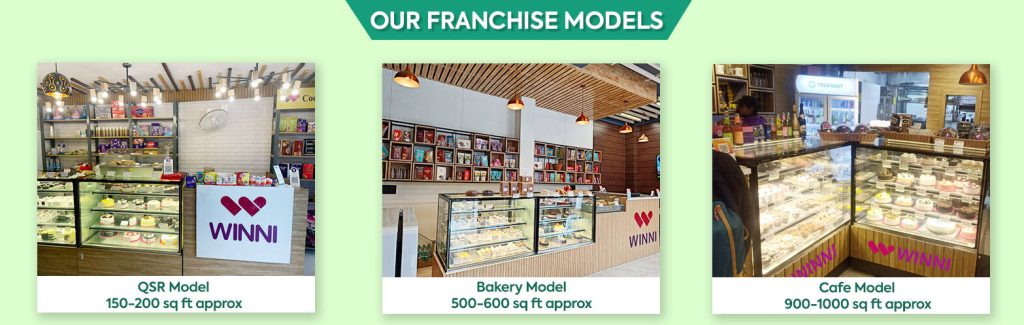
A Winni franchise requires between 200 and 1,200 square feet, with the appropriate size depending on the planned production volume, delivery order capacity, and whether seating is incorporated. Smaller footprints of 200 to 400 square feet work for primarily delivery-and-collection formats; larger outlets with in-store consumption require the upper end of the range. The brand provides guidance on space configuration during site selection to ensure the chosen footprint supports the operational model the franchisee plans to run.
How long does it take to set up and open a Winni Retails Pvt Ltd outlet?
Setup typically takes six to ten weeks from confirmed premises, covering kitchen equipment installation, store fitout to brand standards, FSSAI licensing, initial inventory procurement through the portal, and staff training. Franchisees who initiate FSSAI applications in parallel with physical setup rather than after completion avoid the post-construction delays that licensing backlogs create. The brand's training program is scheduled during this period so the outlet opens with a prepared team rather than training on the job in the first operational weeks.
What training does Winni Retails Pvt Ltd provide before opening?
Training covers proprietary baking recipes and production standards, food cost management protocols, front-of-house service procedures, portal ordering and inventory management, FSSAI compliance requirements, and delivery platform order management. Both kitchen and front-of-house staff are trained, and the 5-year kitchen staff replacement guarantee means that replacement staff receive training before being deployed, maintaining production consistency through team transitions.
Can a Winni Retails Pvt Ltd franchise operate without the owner being present daily?
Daily owner presence during the first 12 months is the consistent differentiator between franchisees who build a loyal repeat customer base quickly and those who take longer to establish the outlet's quality reputation. Once a reliable, trained team is in place and the outlet's operational systems are functioning consistently, reduced owner presence becomes more viable. Full absentee operation — where the owner is rarely physically present — is not well-suited to this format, particularly given the kitchen quality management and customer relationship dimensions that drive repeat purchase in the gifting bakery category.
How many Winni Retails Pvt Ltd outlets are currently operating in India?
The Winni franchise network has between 100 and 200 operational outlets across India, supported by the brand's e-commerce presence in 650 cities. This scale positions the network as an established franchise system with demonstrated multi-market consumer demand and the operational infrastructure to support continued franchisee expansion. The consistent addition of approximately 9.4 new units per year over 16 years indicates a network that has grown through franchisee performance rather than promotional expansion.
Disclaimer: All scores, rankings, and estimates on ForeFind are independently produced editorial assessments using publicly available data and validated brand-submitted information. They are not verified facts, financial advice, or investment recommendations. Full Disclaimer.
