



NV Shoppe’s Position in the Indian Retail Landscape
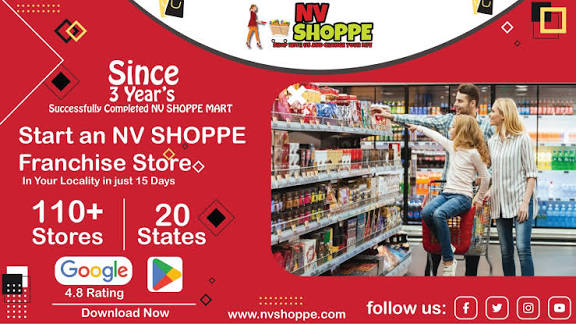
NV Shoppe franchise outlets occupy a specific niche within India’s grocery retail economy: small-format, neighbourhood-first stores designed to sit inside residential catchments rather than compete for footfall in commercial high streets. This format choice is deliberate. Grocery purchasing in India remains a high-frequency, low-ticket habit, and the brand has built its store economics around proximity rather than scale, betting on the household that wants its everyday basket within a five-minute walk rather than a destination shopping trip. That positioning places NV Shoppe closer to the kirana replacement model than to the hypermarket model, competing less on assortment breadth and more on convenience, consistency, and trust in product quality.
The Consumer Demand Case for This Product Category in India
Three structural shifts are converging to favour this kind of store. Indian households are moving steadily from loose, unbranded grocery purchases toward packaged and branded alternatives, a transition driven by rising disposable income and growing comfort with quality assurance over price haggling. Simultaneously, Tier 2 and Tier 3 towns are absorbing a larger share of organised retail investment as metro markets mature and rents climb, pushing brands to chase the next wave of consuming households in smaller cities. Add to this the continuing densification of residential colonies and townships, and a grocery format built around walkable access finds itself with a built-in customer base the moment doors open, well before any marketing spend kicks in. A franchisee opening in a city with rising middle-income housing stock is essentially riding a demand curve that already exists rather than trying to create one.
Why a Branded NV Shoppe Store Outperforms Independent Retail in This Category
An independent grocer starting from scratch has to solve three problems alone that a franchise solves on day one: where to source consistent supply at competitive cost, how to convince first-time customers the store can be trusted, and how to keep shelves curated without years of trial and error. NV Shoppe’s purchasing volume across its existing network gives it negotiating leverage with suppliers that a single independent store cannot replicate, and that leverage typically shows up as either better margins or more competitive shelf pricing, sometimes both. Brand recognition removes the multi-year trust-building period that independent stores must earn one transaction at a time. And because product selection has already been tested across a hundred-plus locations, a new franchisee inherits a working merchandise mix instead of guessing at it. Replicating all three independently would require capital and time well beyond what the franchise investment itself demands.
Geographic Opportunity and Where NV Shoppe Is Expanding
With a network in the 100-200 store range built over roughly a decade and a half of franchising, NV Shoppe has reached a stage where its presence is meaningful in some clusters and still sparse in others. The strongest opportunity tends to sit in Tier 2 cities and the denser residential pockets of Tier 1 peripheries, where new housing supply is outpacing organised grocery retail. Within a city, the format favours residential micro-markets over commercial zones, since the store’s entire value proposition depends on repeat, walk-in family custom rather than transient footfall. Territory decisions are generally made around catchment density and the absence of an existing franchise unit nearby, which means prospective investors evaluating a location should look closely at residential population growth and existing saturation before assuming a city-level opportunity automatically translates into a strong site-level one.
E-Commerce, Quick Commerce, and the Threat to Physical Retail
Grocery is one of the retail categories most exposed to quick commerce disruption, and it would be misleading to suggest otherwise. Ten-minute delivery apps have genuinely shifted some impulse and top-up purchases away from physical stores in dense urban pockets. But the category also has characteristics that cushion physical retail better than, say, apparel or electronics: grocery margins are thin enough that heavily subsidised delivery economics are harder to sustain indefinitely, and a large share of household buying still involves physically inspecting freshness, comparing pack sizes, or making last-minute substitutions that an app interface handles poorly. Smaller residential-format stores like NV Shoppe are also less dependent on the kind of large-basket, planned shopping trip that quick commerce targets, and more dependent on frequent small visits where proximity itself is the competing advantage, not price alone.
Competitive Differentiation: Why Consumers Choose NV Shoppe
What separates NV Shoppe from a generic grocery outlet is the combination of a controlled product list with a residential-first store layout, meaning customers encounter a predictable, manageable shopping experience rather than the overwhelming aisle sprawl of a supermarket. For a household doing daily or near-daily top-up shopping, that predictability has real value: knowing where the staples sit, trusting the freshness standard, and not needing to navigate a large floor for a short list. This works specifically because the format has been kept deliberately simple rather than expanded into a broader hypermarket play, and that restraint is itself the differentiator against both larger organised retail chains and unbranded local stores.
Who Builds a Profitable NV Shoppe Store
Capital is the easy part of this business; understanding the neighbourhood it serves is the harder part. A franchisee who actively tracks what local households are buying, adjusts shelf space around festival cycles and seasonal demand swings, and stays personally involved in day-to-day merchandising will consistently outperform one who treats the store as a passive investment. Because the format is owner-operated by design, with a lean staff of two to eight people handling billing, stocking, and customer service, the owner’s direct presence shapes service quality far more than in a larger format with layers of management. This is why the brand’s target investor profile skews toward small business owners, career changers, and graduate entrepreneurs rather than purely financial investors — the role demands hands-on attention, not just a one-time capital commitment.
Accepting franchise applications in 34 states & UTs
How does NV Shoppe compare to other retail franchises in this investment range?
Within the same investment band, grocery formats like NV Shoppe typically carry lower margins than apparel or services franchises but compensate with higher purchase frequency and a more resilient, recession-tolerant customer base, since groceries remain a non-discretionary spend even when household budgets tighten elsewhere.
Is a NV Shoppe store viable in Tier 2 and Tier 3 Indian cities?
Yes, and arguably more so than in saturated metro markets, since these cities are seeing faster growth in organised retail adoption and still have residential pockets without a comparable branded grocery option nearby.
How does NV Shoppe handle competition from e-commerce in this product category?
The format leans on proximity-driven, frequent small-basket shopping behaviour that quick commerce apps serve less efficiently than they serve large, planned orders, which keeps physical footfall relevant even as online grocery grows.
What is NV Shoppe's national marketing strategy and how does it benefit franchisees?
Brand-level marketing concentrates on building category trust and repeat recognition across the network, which lowers the customer-acquisition burden on any single franchisee compared to an unbranded store starting from zero awareness.
What is the NV Shoppe store expansion plan for the next two years?
Given an average pace of close to ten new units annually over recent years, expansion is likely to continue concentrating on residential micro-markets in Tier 2 cities and underpenetrated suburbs of larger metros, in line with the brand's existing footprint pattern.
Disclaimer: All scores, rankings, and estimates on ForeFind are independently produced editorial assessments using publicly available data and validated brand-submitted information. They are not verified facts, financial advice, or investment recommendations. Full Disclaimer.
