


Dale Carnegie Training Franchise: Investment, Fee Structure and Return Potential in India
For an investor evaluating the Dale Carnegie Training franchise, the starting point is not the investment quantum but what that investment buys access to: a professional development curriculum that has been delivered commercially since 1912, now operating across more than 80 countries and, within India, through a network that has added an average of over nine new franchise units per year across its sixteen-year operating history. That pace of expansion, sustained over more than a decade, is the kind of signal that distinguishes a tested model from an early-stage concept asking franchisees to absorb market development risk.
About Dale Carnegie Training
Dale Carnegie Training occupies a specific and defensible position in the Indian corporate training landscape. Its programmes focus on interpersonal effectiveness, leadership capability, communication skills, and sales performance — competencies that sit at the centre of every organisation’s people development agenda, regardless of industry or economic cycle. Delivery targets working professionals, team leaders, and mid-to-senior management rather than students preparing for academic examinations. Franchise partners in India serve both corporate clients commissioning group training for their employees and individual professionals self-funding skill development for career advancement.
The methodology is proprietary, updated periodically to reflect contemporary business environments, and delivered only by trainers who have completed Dale Carnegie’s certification process. That credential requirement is not incidental — it is the mechanism through which the brand maintains consistent quality across 100 to 200 franchise locations in India, ensuring that a programme sold under the Dale Carnegie name in Chennai delivers an experience comparable to one sold in Delhi.
How Revenue Is Generated in a Dale Carnegie Training Centre
Revenue in a Dale Carnegie franchise flows through two distinct channels, each with different predictability characteristics. Corporate contracts — where a company commissions training for a batch of employees — generate larger per-engagement revenue but require active business development effort to secure and can be irregular in timing. Individual enrolments, where professionals register for open programmes, create a more consistent stream but depend on sustained marketing and local brand presence to maintain intake volume.
Unlike a school tutoring centre that collects monthly fees across a fixed academic year, the Dale Carnegie model is programme-based: revenue is recognised when a course runs, which means a franchisee’s monthly income reflects both how many programmes they can schedule and how fully those programmes are enrolled. The indicative monthly revenue range given in the brand data suggests meaningful variance between a centre running at partial capacity versus one with a full corporate pipeline and consistent individual enrolment — a spread that reflects the B2B sales skill of the franchisee as much as local market demand.
The Investment and What It Covers
The ₹10 lakh to ₹20 lakh investment range funds several distinct categories of expenditure. The franchise fee provides access to the Dale Carnegie curriculum, the brand licence, and initial certification training for the franchisee and core trainers. Centre setup within the 850 to 1,000 square foot space requirement covers furniture, presentation equipment, audio-visual systems, and the professional environment that corporate clients expect when sending employees for training. A portion of the investment typically covers working capital to sustain operations through the ramp-up period before recurring revenue stabilises.
Monthly recurring costs include royalty payments calculated on revenue, a marketing contribution that funds national brand activity, staff salaries for the two-to-eight person team, and rent on the centre premises. Of these, staff cost is the variable that scales most directly with programme volume: a lean operation running a small number of corporate programmes can function with two or three people, while a centre running multiple simultaneous open programmes across different topic areas will require a larger team of certified trainers. Understanding that staffing cost is programme-volume-linked, rather than fixed, is important for modelling the break-even trajectory realistically.
Enrollment Cycle, Seasonality, and Revenue Predictability
Corporate training budgets in India tend to concentrate spending in two periods: the financial year beginning in April, when L&D plans are activated and budgets are fresh, and the October-December quarter, when companies deploy remaining annual training spend before year-end. A Dale Carnegie franchise that maintains active corporate relationships can align programme scheduling to these cycles and build predictable revenue around them. The lean periods — typically July to September and February to March — require advance pipeline development to avoid significant revenue gaps.
The individual professional enrolment stream provides some counter-cyclical cushion. Professionals who are between jobs, recently promoted, or preparing for role changes seek out development programmes independently of corporate budget cycles. A franchise that balances corporate contracts with open enrolment programmes is structurally more insulated from seasonal dips than one that depends entirely on either channel. Building that balance is a deliberate operational task, not an automatic outcome, and franchisees who invest in both B2B relationship management and individual lead generation consistently demonstrate shorter break-even timelines.
What the Franchisor Provides and Its Real Value
The most financially significant asset Dale Carnegie provides is name recognition within the corporate training procurement process. An HR manager at a mid-sized company evaluating training providers for a leadership programme will respond to the Dale Carnegie brand differently than to an independent training firm of equivalent quality — because the brand signals a standardised methodology, global validation, and accountability. That recognition compresses the sales cycle for a franchisee and reduces the cost of building credibility from scratch, which, for an independent operator, can take three to five years and significant marketing investment.
Beyond brand, the franchisor supplies certified curriculum materials, trainer certification and recertification processes, assessment tools for measuring participant outcomes, and periodic curriculum updates that keep content relevant to current business practice. The value of this package, if constructed independently, would represent a multi-year development investment — one that most individual operators cannot fund or sustain while simultaneously running a training business.
Risk Factors Specific to Education Franchises in India
Four risks merit honest examination. Online training platforms have expanded significantly in India, offering professional development content at price points well below in-person programme fees. Dale Carnegie’s differentiation from this channel lies in the group dynamics and facilitated application elements of its methodology — outcomes that video-based self-paced learning cannot reliably replicate. The risk is real but manageable for franchisees who position the in-person experience as distinct from digital alternatives rather than competing on price.
Trainer retention is the operational risk that catches most corporate training franchisees unprepared. A certified Dale Carnegie trainer who leaves to join a competing firm or set up independently takes client relationships and delivery capability with them. Franchisees who build their delivery model around two or three trainers carry concentrated personnel risk; those who invest in a slightly larger, cross-trained team are structurally more resilient. Policy risk, by contrast, is lower in this category than in school education — professional training is not subject to board affiliation requirements, and regulatory exposure for a trade-licensed GST-registered training centre is limited to standard commercial compliance.
Who This Investment Suits
The Dale Carnegie Training franchise consistently produces strong returns for franchisees with two specific assets: an existing professional network in the corporate or HR community of their city, and the sales capability to convert that network into programme bookings. A former L&D manager, a senior sales professional with deep industry relationships, or an experienced trainer moving into business ownership brings ready-made pipeline credibility that a new-to-market investor cannot substitute with marketing spend alone. In cities where manufacturing, financial services, or technology companies have significant employee populations, that corporate network translates directly into programme revenue.
Someone who expects the brand name alone to generate inbound corporate enquiries without active relationship management will find the 9-to-18-month break-even timeline stretching toward its upper boundary rather than its lower one.
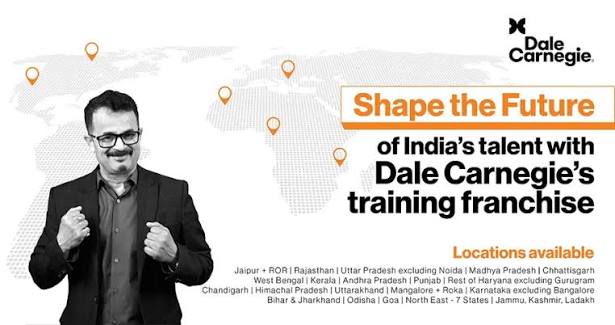
Accepting franchise applications in 32 states & UTs



How much does it cost to open a Dale Carnegie Training franchise in India?
The total investment falls in the ₹10 lakh to ₹20 lakh range, covering the franchise fee, centre setup within 850 to 1,000 square feet of space, trainer certification, and initial working capital. The spread within that range reflects differences in city-specific rental costs and the extent of audio-visual and furniture fitout required for the training environment.
What is the expected monthly revenue from a Dale Carnegie Training centre?
Indicative monthly revenue ranges from ₹1.3 lakh to ₹5.2 lakh, with actual performance depending on the balance between corporate contract volume and individual open-programme enrolments. Centres with an active B2B pipeline and consistent corporate bookings tend to operate toward the upper end of this range, while centres still building their corporate client base generate revenues closer to the lower bound during the first year.
How many students or participants does a Dale Carnegie Training centre need to reach break-even?
Break-even is driven by programme revenue relative to monthly fixed costs — primarily rent, staff salaries, and royalty payments. Rather than a participant headcount, the more useful metric is programme revenue per month. A centre covering ₹1.5 lakh to ₹2 lakh in monthly fixed costs needs to generate that revenue consistently through a combination of corporate programme fees and individual enrolment income. That typically requires two to three actively running programmes per month at standard fee levels.
Does Dale Carnegie Training help with teacher recruitment and trainer certification?
Yes. Trainer certification is a mandatory element of the Dale Carnegie franchise model — all delivery staff must complete the company's certification process before delivering programmes commercially. The franchisor manages this certification pathway and provides the training required to bring new trainers up to the required standard. For franchisees in cities where experienced corporate trainers are scarce, this structured certification process means the hiring pool is broader than only pre-certified candidates.
Is Dale Carnegie Training suitable for Tier 2 and Tier 3 cities in India?
Suitability depends heavily on the local corporate employer base. Cities with manufacturing clusters, regional banking headquarters, technology parks, or mid-sized SME industries generate consistent demand for leadership, communication, and sales effectiveness training. The Dale Carnegie franchise model has operated profitably in several non-metro markets in India where a franchisee with strong local corporate relationships was able to convert existing professional credibility into programme bookings within the first year of operation.
Disclaimer: All scores, rankings, and estimates on ForeFind are independently produced editorial assessments using publicly available data and validated brand-submitted information. They are not verified facts, financial advice, or investment recommendations. Full Disclaimer.
