


CompTIA (Computing Technology Industry Association) Franchise: Education Market Opportunity, Brand Position and Growth Potential
The CompTIA franchise opportunity sits at an intersection that Indian investors rarely find at this entry price point: a globally credentialed IT certification body operating through a local, owner-managed delivery model. For an investor evaluating the education sector, what CompTIA brings is not simply a tutoring centre concept but access to a certification ecosystem trusted by employers across 60 countries — deployed through a business structure sized for Indian market realities.
CompTIA (Computing Technology Industry Association) in the Context of India’s Education Franchise Market
India’s supplemental education market segments along two broad axes: academic support (tuition, test prep) and skills certification (vocational, professional). CompTIA occupies the second category, specifically the IT certification segment, where demand comes not from students preparing for board exams but from working professionals, career switchers, and technically inclined young adults seeking employer-recognised credentials. This distinction matters for site selection and customer acquisition — the typical CompTIA learner is older than a tuition centre’s audience and making a deliberate career investment rather than responding to exam pressure.
Geographically, the model is positioned for residential neighbourhoods and high-street locations in both metros and smaller cities, with no minimum area requirement. An independent training institute attempting to deliver CompTIA content would need to source curriculum, negotiate authorisation, and establish market credibility without brand support. A franchisee steps into an authorised delivery relationship with an existing global credential — the economic difference between building trust from scratch and inheriting it is considerable, particularly in a market where learners scrutinise certification authenticity before enrolment.
Why Demand for This Education Format Is Growing in India
Several structural forces have converged to expand the addressable market for IT certification training in India. The National Education Policy 2020 embedded vocational and skill-based learning into the mainstream curriculum conversation, accelerating institutional and parental acceptance of non-academic credentials. Simultaneously, Skill India and its associated NSDC framework created a policy environment that recognises globally aligned certifications as legitimate workforce development tools — which reduces the persuasion burden on any centre operator explaining CompTIA’s value to a prospective learner.
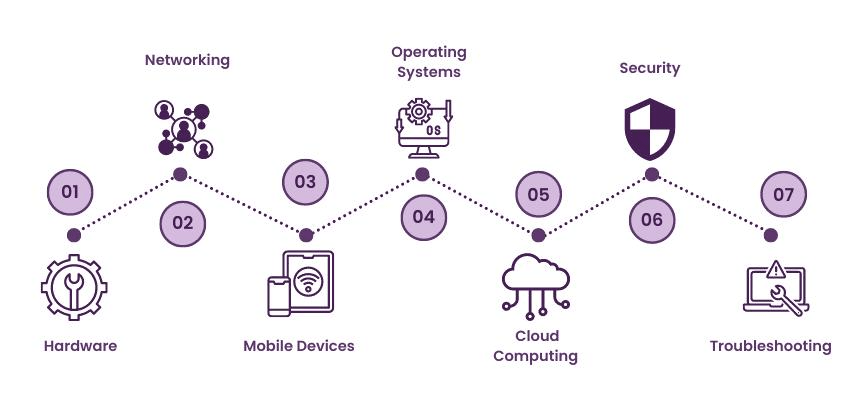
Post-pandemic, hybrid and remote work normalised across Indian industries, and with that normalisation came a renewed employer focus on verifiable technical skills. Certifications that demonstrate competency in hardware, networking, cybersecurity, and cloud fundamentals became more visible in job descriptions. Organised franchise models benefit disproportionately from this shift because they can update delivery and marketing faster than isolated independent centres, and because a national brand affiliation signals legitimacy in a way that a solo operator cannot easily replicate.
What CompTIA (Computing Technology Industry Association) Gives a Franchisee That They Cannot Build Alone
The core asset is the certification IP itself. CompTIA’s 18 certification programs — covering hardware, networking, security, and adjacent technical domains — are developed and maintained by the global association, not by the franchisee. An independent trainer could teach similar content, but the credential attached to that training would carry no weight with an employer in Singapore, the UK, or the United States. The franchisee is not simply selling instruction; they are selling an outcome that has market value beyond India’s borders, and that outcome is only available through an authorised channel.
Beyond the credential, the franchisor provides marketing support, field assistance, and operating documentation that reduce the time from setup to revenue. For a first-time entrepreneur or a salaried professional transitioning into business ownership, the pre-launch and post-launch support structure addresses the operational uncertainty that causes most independent education startups to underperform in their first year. The break-even window of two to six months reflects, in part, the value of entering the market with a pre-built demand signal rather than spending those months on brand establishment.
The CompTIA (Computing Technology Industry Association) Network: Growth Rate and Geographic White Space
Six hundred operational centres across an eleven-year franchise history, with approximately 54 to 55 new units opening each year on average, represents a network that has demonstrated consistent replication. That pace of expansion is neither the explosive growth of a heavily capitalised consumer brand nor the stagnation of a concept that has reached saturation. It suggests a model that opens when the right franchisee is in place rather than one driven by aggressive territorial sales.
For an investor, the implication is geographic: at 600 centres across India, the network remains materially underpenetrated relative to the country’s 4,000-plus cities and towns with populations above 20,000. Tier 2 and Tier 3 cities, where IT sector employment is growing faster than in metros due to infrastructure investment and remote work adoption, represent the clearest expansion frontier. Territory allocation in education franchises of this type typically follows demand concentration — population density, proximity to engineering colleges, and local employer composition all influence where the franchisor is likely to support new openings.
Competitive Positioning: Why Parents and Learners Choose CompTIA (Computing Technology Industry Association) Over Alternatives
In the IT certification segment, the purchase decision is driven less by pedagogy and more by outcome credibility. A learner in Nagpur or Coimbatore evaluating certification options is asking one question before any other: will this credential be recognised by the employer or recruiter I am targeting? CompTIA’s membership roster — which includes IBM, Microsoft, Cisco, HP, Apple, and Lenovo — answers that question in a way that a regional or domestic certification body cannot. The brand association does the competitive work that an independent institute would need to build over years.
Against competing education franchises at a similar investment tier, CompTIA’s differentiation lies in the global-to-local proposition. Most domestic coaching franchises are competing within India’s internal education economy. CompTIA is positioning its learners for international employment standards, which carries a premium in aspiration-driven markets where families view education spending as a long-term career investment.
Policy and Regulatory Risk in the Indian Education Sector
Education franchises in India operate within a layered regulatory environment: central frameworks like NEP and Skill India, state-level recognition requirements, and sector-specific guidelines from bodies like NSDC. For a certification-focused franchise like CompTIA, the regulatory exposure differs from that of a conventional school or tuition centre. No mandatory licensing is required to operate, which reduces setup friction and removes one category of regulatory dependency.
The more relevant risk is curriculum or accreditation change — if employer recognition of a specific certification shifts, or if NSDC alignment standards evolve, the franchisee’s commercial model is affected. This is where the franchisor’s global position provides a degree of insulation: CompTIA certifications are maintained and updated at the international level, and the association’s relationships with global technology employers create a buffer against domestic policy-driven disruption that smaller certification bodies do not have. The investor’s residual exposure is primarily to local demand fluctuations rather than to existential curriculum risk.
Who Captures the Most Value From a CompTIA (Computing Technology Industry Association) Franchise
The franchisee profile that extracts the most from this model combines two things that do not always appear together: local community credibility and operational discipline. A teacher or subject-matter expert with an existing professional network in their city — particularly one with connections to engineering colleges, corporate HR teams, or skill development institutes — can activate demand faster than someone starting from a cold network. The low investment threshold means the model is accessible to salaried professionals running it as a primary or transitional business and to retired individuals with both community standing and time to invest in centre operations.
Seasonality affects enrolment cycles, and capital sensitivity means that the franchisee’s working capital management in lean months determines whether the centre reaches and sustains profitability. The two-to-eight staff requirement gives the operator flexibility to scale cost with revenue — a critical feature for a business that may run lean in its first quarter and grow rapidly once employer referrals and alumni word-of-mouth build. The CompTIA franchise rewards operators who understand their local employment market and position the centre as a career infrastructure resource rather than a generic training venue.
Accepting franchise applications in 34 states & UTs
How does CompTIA (Computing Technology Industry Association) compare to other education franchises at this investment level?
Most education franchises in the INR 50,000 to 2 lakh range operate in the academic tuition segment, where competition is dense and differentiation is difficult. CompTIA occupies a distinct position by delivering globally recognised IT certifications rather than curriculum support. The credential has international employer recognition, which is an asset that comparably priced domestic coaching brands cannot offer.
Is CompTIA (Computing Technology Industry Association) suitable for Tier 2 and Tier 3 cities?
The model is designed for residential and high-street locations with no area requirement, which aligns well with the real estate economics of smaller cities. IT sector employment is expanding in Tier 2 and Tier 3 markets through remote work and infrastructure investment, and the target learner — a working professional or recent graduate seeking a verifiable technical credential — is present in these markets in growing numbers.
What is CompTIA (Computing Technology Industry Association)'s student outcome track record?
CompTIA certifications are accepted by technology employers across more than 60 countries, and the association's membership includes major global hardware and software companies. The certification programs are periodically updated to reflect current industry requirements, which keeps the credential relevant in a technology sector where skill standards evolve quickly.
How does CompTIA (Computing Technology Industry Association) handle changes in education policy or curriculum?
Because CompTIA certifications are governed by a global non-profit association rather than a domestic curriculum board, changes to India's national education policy have limited direct impact on the certification content. The franchisor maintains the curriculum at the international level in response to employer and industry input, which means the franchisee's product is updated through the franchisor relationship rather than through local regulatory compliance.
What is the CompTIA (Computing Technology Industry Association) franchise expansion plan for India?
The network has added centres at a consistent pace since its franchising launch, with the current base reflecting eleven years of operation. Expansion focus areas are likely to follow IT employment growth corridors — secondary cities in Tier 2 markets where engineering college density, corporate park development, and remote work adoption are creating demand for internationally credentialed technical training. Investors in geographies with those characteristics are positioned to benefit from early entry before competing franchise units are established nearby.
Disclaimer: All scores, rankings, and estimates on ForeFind are independently produced editorial assessments using publicly available data and validated brand-submitted information. They are not verified facts, financial advice, or investment recommendations. Full Disclaimer.
