


Delhi Paramedical & Management Institute Franchise: Education Market Opportunity, Brand Position and Growth Potential
Few education franchises in India carry the institutional weight that comes with nearly five decades of operation. The Delhi Paramedical & Management Institute franchise enters investor conversations with a history that pre-dates most of its competitors in the vocational training space — a founding year of 1976 places it in an entirely different generation from brands that launched in the post-liberalisation education boom. For an investor evaluating the mid-investment education category, that longevity is not merely a talking point; it represents accumulated curriculum development, regulatory navigation experience, and brand recall in communities where the institute’s graduates are already part of the working population.
Delhi Paramedical & Management Institute in the Context of India’s Education Franchise Market
Paramedical and healthcare-adjacent vocational training occupies a specific and underserved corner of India’s education market. Unlike tutoring or test preparation — categories crowded with both franchise operators and independent instructors — structured paramedical training requires regulatory credibility, clinical curriculum frameworks, and institutional recognition from healthcare employers. These barriers to entry are precisely what make the category less competitive and more defensible for an established operator.
The student demographic served by this model sits in the middle-income bracket: families who cannot absorb the cost of a full medical degree but want their children positioned for stable, respected employment in the healthcare system. This segment is substantial and growing across Tier 2 and Tier 3 cities, where government hospital expansion and private clinic proliferation are creating consistent demand for trained paramedical staff at the ward and clinic level. An independent centre attempting to serve this market faces immediate credibility questions from prospective students — questions that a franchise carrying the Delhi Paramedical & Management Institute name does not face in the same way.
Why Demand for This Education Format Is Growing in India
India’s healthcare sector is structurally understaffed at the paramedical level. For every physician the country trains, the system requires multiple support professionals — lab technicians, physiotherapy assistants, radiography operators, nursing aides — and the training infrastructure for these roles has never kept pace with hospital expansion. The Skill India mission identified healthcare as one of the highest-priority sectors for structured vocational development precisely because this gap was measurable and growing.
The National Education Policy 2020 reinforced this direction by formally elevating vocational training pathways within the education system, reducing the stigma that had historically made skill-based programmes less attractive to middle-income families than conventional academic routes. Post-COVID, the perception of healthcare employment shifted further — job security in the sector was visible and tangible in a way that many other employment categories were not during the disruption. Organised franchise models benefit from this environment more directly than independent operators because they can demonstrate curriculum alignment with national frameworks, NSDC affiliation pathways, and placement networks with healthcare employers — all of which require institutional infrastructure that a solo trainer cannot readily assemble.
What Delhi Paramedical & Management Institute Gives a Franchisee That They Cannot Build Alone
Building a paramedical training curriculum from scratch is not simply a content challenge — it is a regulatory and clinical accuracy challenge. Course materials must reflect current medical protocols, assessment frameworks must meet standards recognisable to healthcare employers, and the entire programme must be structured in a way that allows students to sit for external certifications that actually carry value in the job market. Delhi Paramedical & Management Institute’s curriculum, developed and refined over decades of actual delivery, represents an asset that a new franchisee receives immediately rather than spending years constructing.
Beyond curriculum, the brand’s name recognition in communities where its graduates are working creates a referral dynamic that independent operators cannot manufacture. When a student already employed in a local hospital mentions where they trained, that word-of-mouth carries institutional weight. The franchisor’s national marketing presence and the network of 50-plus centres also means that prospective students searching for paramedical training online encounter the brand before they encounter individual independent institutes — a search visibility advantage that compounds with network scale.
The Delhi Paramedical & Management Institute Network: Growth Rate and Geographic White Space
A network in the 50-to-100 centre range, built at approximately 1.5 new centres per year, reflects a growth approach that has prioritised operational quality over aggressive territory expansion. The implication for an investor evaluating a new location is meaningful: the franchisor has not blanketed the country with centres, which means viable territory in most Indian states remains genuinely open. Healthcare training demand is not geographically concentrated — it follows hospital and clinic distribution, which spans district headquarters, semi-urban towns, and satellite cities around major metros.
Territory allocation in this model typically assigns protected zones around each centre, preventing internal network competition in the same locality. For an early mover in a district that currently has no Delhi Paramedical & Management Institute presence, the combination of a protected territory and growing healthcare employer demand in that area represents the most favourable conditions available in this category. The key question during due diligence is whether the target city has the healthcare infrastructure density — in terms of hospitals, clinics, and government health centres — to generate consistent graduate employment, since that employment rate is ultimately what drives enrolment referrals in the following admission cycle.
Competitive Positioning: Why Parents Choose Delhi Paramedical & Management Institute Over Alternatives
The comparison a family in a Tier 2 city makes is rarely between two franchise brands. More often, it is between a recognised institute name and a locally operated training centre run by an individual with relevant credentials but no institutional backing. In that comparison, the Delhi Paramedical & Management Institute carries three advantages that are difficult for the independent operator to counter: a multi-decade operating history that parents can verify, a certification framework that healthcare employers in the region have encountered before, and a structured course duration and curriculum that signals seriousness of intent rather than informal coaching.
For students themselves, the placement assistance and employer network that an established brand can offer — even informally through alumni connections across its centre network — represents a practical outcome advantage over completing the same course with a local trainer. In a category where the end goal is a job, that placement dimension is often the deciding factor in a family’s enrolment decision.
Policy and Regulatory Risk in the Indian Education Sector
Paramedical education sits at the intersection of education policy and healthcare regulation, which means franchisees are exposed to potential changes from two regulatory directions simultaneously. NSDC and NCVT affiliation provide a national framework that offers some stability, but state health departments and state medical faculties also periodically revise recognition requirements for paramedical training centres. A franchisee operating independently through such a change would carry the full burden of legal interpretation, documentation, and re-application.
The structural advantage of a franchise network in this context is that regulatory changes affecting one centre tend to affect all centres simultaneously — meaning the franchisor has an operational incentive to monitor, interpret, and respond to those changes centrally. Investors should confirm, during the agreement process, what specific support the franchisor provides when an affiliation renewal or state recognition requirement changes. The royalty structure — which implies an ongoing commercial relationship between franchisor and franchisee — creates a shared interest in maintaining each centre’s compliance standing that a purely transactional licence model would not.
Who Captures the Most Value From a Delhi Paramedical & Management Institute Franchise
The franchisee profile that consistently builds a high-performing Delhi Paramedical & Management Institute centre combines two things that capital alone cannot provide: existing credibility within the local healthcare or education community, and the operational discipline to manage a centre running multiple batches across different programme tracks simultaneously. A career changer with a clinical background, a graduate entrepreneur with family connections in local healthcare institutions, or a small business owner who already operates in the education or training space — these profiles bring community trust that shortens the enrolment ramp considerably. Geographic fit matters as much as capital in this evaluation: a franchisee opening in a district with active hospital expansion and limited existing paramedical training options is starting from a fundamentally better demand position than one entering a saturated urban market, regardless of how well-capitalised they are.
Accepting franchise applications in 33 states & UTs



Q: What is the investment required for a DPMI franchise?
A: Initial investment ranges from INR 5 Lakh to 10 Lakh depending on location and infrastructure.
Q: How does the DPMI franchise business operate?
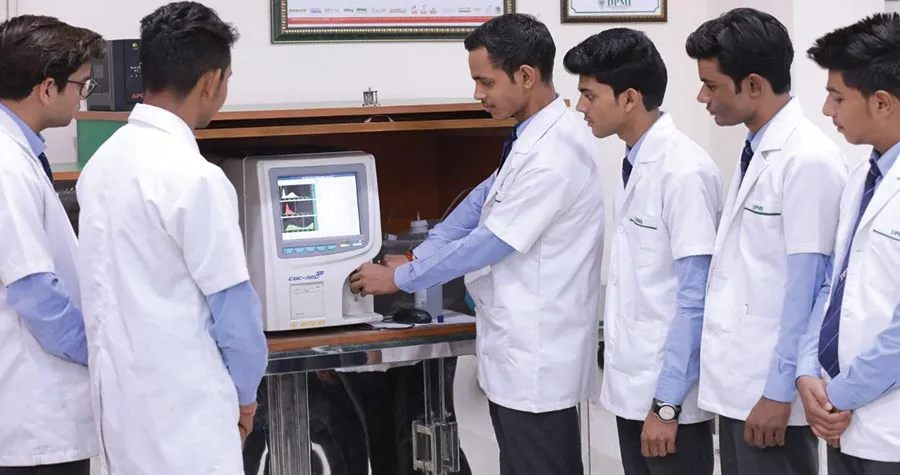
A: Franchisees manage educational centers offering paramedical, hospitality, and management courses. Curriculum delivery, student assessments, and certification are coordinated through DPMI systems.
Q: What space is required for the franchise?
A: Centers typically require 2,000–3,500 sq.ft, including classrooms, labs, and administrative areas.
Q: How long does it take to recover the investment?
A: Expected payback period ranges between 6 to 11 months depending on student enrollment and operational efficiency.
Q: How can investors apply for the franchise?
A: Prospective franchisees can contact DPMI directly to evaluate locations, investment plans, and start the franchise onboarding process. ## Similar Franchise Opportunities
Disclaimer: All scores, rankings, and estimates on ForeFind are independently produced editorial assessments using publicly available data and validated brand-submitted information. They are not verified facts, financial advice, or investment recommendations. Full Disclaimer.
