



Shri Chyawan Ayurveda Franchise: Store Investment, Margins and Return Timeline in India
The Shri Chyawan Ayurveda franchise operates in one of the most structurally favourable segments of Indian retail: herbal and Ayurvedic products, where consumer demand has grown consistently over the past decade and where the shift from unorganised local suppliers to branded manufacturers has created significant space for organised retail formats. With 200 to 500 stores across India and an average of nearly 30 new units opening per year, the brand’s expansion rate signals genuine franchisee demand — and for a retail investor focused on margins, inventory economics, and return on capital, the questions that matter are how the unit economics actually work at 500 square feet.
About Shri Chyawan Ayurveda
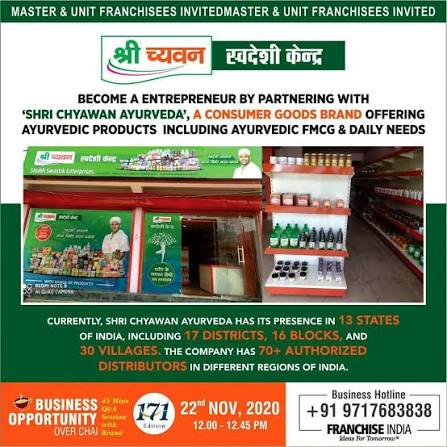
Founded in 2013 and active in franchising for twelve years, Shri Chyawan Ayurveda manufactures and retails a product range of over 250 Ayurvedic, FMCG, and daily care items — covering health supplements, herbal formulations, personal care, and household wellness products. The consumer segment is broad: families seeking alternatives to pharmaceutical or synthetic personal care products, health-conscious individuals, and the growing demographic that treats Ayurvedic products as part of routine daily use rather than occasional remediation. A product catalogue of 250-plus SKUs means a single store can serve a wide range of household needs from a compact 500 square foot format, which is what drives the revenue-per-square-foot potential in this model. The brand’s scale — hundreds of operational stores across geographies — is the most relevant signal for a retail investor: it indicates that consumer demand exists and is being captured repeatedly across diverse Indian markets, not just in select metro pockets.
The Margin and Inventory Model
Ayurvedic and herbal FMCG retail operates at gross margins that are generally higher than mass-market grocery but require attention to inventory turnover to realise their potential. In this category, branded herbal products typically carry gross margins in the 25 to 40 percent range at the retail level, depending on the product type and whether the brand sells through the franchisee at MRP with a margin built in or at a trade price with the franchisee setting final retail pricing within defined limits. The inventory model in a franchise system like this typically requires the franchisee to purchase stock upfront from the franchisor at the trade price — the franchisee carries inventory risk rather than operating on consignment. That means working capital management is a key operational discipline: slow-moving SKUs tie up cash, and a franchisee who over-stocks based on anticipated demand rather than observed sales patterns will feel the strain on monthly cash flow. The brand’s 250-plus product range provides flexibility to curate what sells in a specific market rather than stocking everything uniformly.
Store Economics: Revenue Per Square Foot and Monthly Fixed Costs
A 500 square foot Shri Chyawan Ayurveda store with indicative monthly revenue of INR 2 lakh to 8 lakh implies revenue per square foot of INR 400 to 1,600 per month — a range that reflects the difference between a store in early enrollment phase and one operating at mature volume with a regular customer base. To understand what the store needs to generate daily to cover costs: at a monthly fixed cost structure of approximately INR 80,000 to 1,20,000 — covering rent in a residential or high-street location, three to four staff members, royalty or brand fees, and utilities — the store needs daily sales of roughly INR 2,700 to 4,000 to break even. At the midpoint of the revenue range, a mature store operating with consistent foot traffic and a loyal repeat-purchase customer base clears that threshold with meaningful headroom. The nine-to-eighteen-month break-even range reflects how long it typically takes to reach that mature volume level — stores in high-footfall locations with strong local brand awareness converge toward nine months; those in lower-traffic or newly established markets extend toward eighteen.
The Investment Breakdown and What It Covers
The INR 5 lakh to 10 lakh investment covers store setup across several components: the franchise or brand licence fee, store fit-out and fixtures designed to the franchisor’s specification, opening inventory across a representative range of SKUs, initial training for the franchisee and core staff, and working capital for the first operating months before revenue stabilises. The range reflects real variation — a store in a location requiring significant fit-out work, or where opening inventory needs to be broader to cover diverse consumer demand, will sit toward the upper end. Monthly recurring costs after opening include procurement for inventory replenishment (the dominant variable cost line), staff salaries for three to ten employees depending on operating hours and store volume, rent, and any ongoing brand or royalty fees. Investors who model their monthly cost floor carefully before committing will be better positioned to manage the early months when revenue is still building.
Seasonality and Demand Peaks in This Category
Ayurvedic and wellness product demand follows two seasonal patterns that a franchisee should plan inventory around. The October-to-January period — covering Diwali gifting, winter health concerns, and the festive gifting culture — typically drives the highest transaction volumes, with health tonics, immunity products, and gift-packaged herbal items seeing elevated demand. A secondary peak occurs around March-April when pre-summer health and wellness purchases drive another inventory cycle. Lean months — primarily July and August — see lower discretionary health product spending, though daily care and personal hygiene products within the 250-SKU range continue to move. The strategic response is forward inventory planning ahead of the October and March peaks, and a lean stock position during monsoon months to preserve working capital. Staffing can be adjusted at the margin by adding part-time help during peak periods rather than maintaining peak staffing year-round.
Online Competition and the Omnichannel Reality
Ayurvedic and herbal products are among the most actively sold categories on Indian e-commerce platforms — Amazon, Flipkart, and direct-to-consumer brand websites all carry extensive herbal product ranges. A Shri Chyawan Ayurveda franchisee is operating in a category where the consumer can price-compare online before walking into the store. The physical store’s advantage lies in immediacy, the ability to seek advice on products, and the trust that comes from buying a product from a dedicated brand outlet rather than a third-party seller whose authenticity is uncertain. A franchisee who trains staff to engage with customer questions — rather than operating as a pure transaction counter — builds the advisory relationship that online channels cannot replicate. Whether Shri Chyawan Ayurveda integrates its franchisee network into an online ordering or click-and-collect system is worth discussing during the franchise evaluation, as it would provide an additional revenue channel that complements rather than competes with the physical store.
Who This Retail Investment Suits
The investor who generates strong same-store sales growth in this format is someone with genuine interest in the wellness and Ayurvedic product category — someone who uses the products, can speak credibly about them, and finds the advisory dimension of the business engaging rather than burdensome. Career changers from healthcare or pharmacy backgrounds carry an immediate credibility advantage with health-conscious consumers. Small business owners familiar with FMCG retail operations bring the inventory management discipline the model requires. Graduate entrepreneurs with community connections in their target neighbourhood build the local referral base that sustains repeat purchases. A retail investment treated as a passive income source — where the owner is absent and staff are left to manage without supervision or product knowledge — will consistently produce revenue at the lower end of the range, because in wellness retail, the owner’s engagement with customers is the primary driver of basket size and return visits.
Accepting franchise applications in 35 states & UTs



How much does it cost to open a Shri Chyawan Ayurveda franchise store?
The total investment required falls between INR 5 lakh and INR 10 lakh, covering the brand licence fee, store fit-out and fixtures, opening inventory, training, and initial working capital. The final figure within that range depends on the location's fit-out requirements, the size of the opening stock selected, and local real estate costs.
What is the expected monthly revenue from a Shri Chyawan Ayurveda store?
Indicative monthly revenue ranges from INR 2 lakh to INR 8 lakh. Stores in the lower part of that range are typically in their first six to twelve months of operation, while those approaching the upper end are mature stores with an established regular customer base and strong inventory management. The trajectory from lower to higher revenue is driven primarily by how quickly the franchisee builds repeat-purchase relationships with local consumers.
Does Shri Chyawan Ayurveda provide inventory on credit or consignment to franchisees?
In the standard franchise retail model for this category, franchisees purchase inventory from the franchisor at a trade price and carry the inventory risk themselves. Credit terms — whether any portion of the opening or replenishment stock can be purchased on deferred payment — vary by franchisor and are worth confirming directly during the due diligence process. Working capital planning should assume upfront inventory procurement as the baseline.
What is the Shri Chyawan Ayurveda franchise territory and exclusivity policy?
Territory exclusivity — the radius within which the franchisor will not open another store — is a key term to confirm before signing. Given the brand's expansion rate of approximately 30 new units per year, understanding how catchment areas are defined and protected is important for a franchisee's long-term revenue security. The specific terms should be reviewed in the franchise agreement with appropriate professional guidance.
How many Shri Chyawan Ayurveda stores are currently operating in India?
The network spans between 200 and 500 operational stores across India. That scale, built over twelve years of franchising, reflects a model that has been validated across diverse geographies and market conditions — and it indicates that the franchisor has the operational infrastructure to support new franchisees entering the system rather than being stretched thin by rapid early-stage expansion.
Disclaimer: All scores, rankings, and estimates on ForeFind are independently produced editorial assessments using publicly available data and validated brand-submitted information. They are not verified facts, financial advice, or investment recommendations. Full Disclaimer.
