



Hariom Electronics Franchise: Market Position, Consumer Demand and Competitive Advantage in Indian Retail
Hariom Electronics’s Position in the Indian Retail Landscape
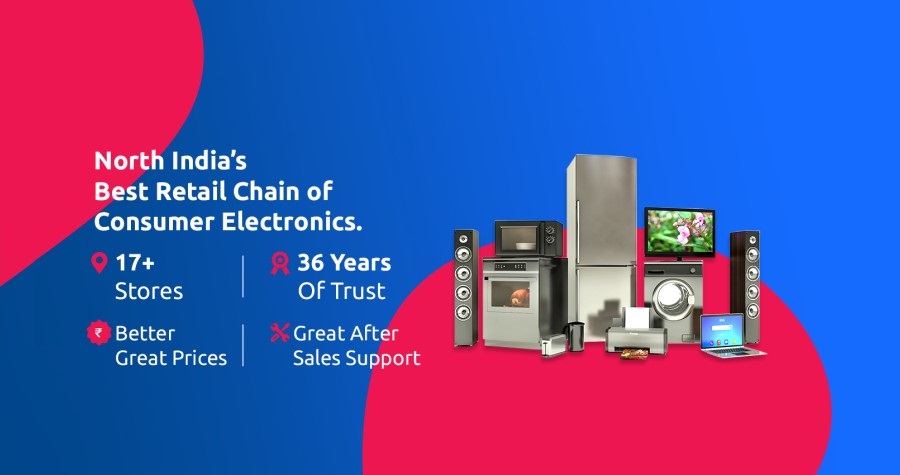
The Hariom Electronics franchise occupies a mid-format position in India’s organised consumer electronics retail segment — large enough to carry meaningful category depth across appliances, home electronics, and related durables, but structured around a 2,000 to 2,200 square foot footprint that keeps location costs manageable relative to the large-format chains. Founded in 1984, the brand brings over four decades of operating history in electronics retail, a period that spans the analogue-to-digital transition, the rise of mobile, and now the connected-home era. Its franchising model, formalised in 2019, reflects a deliberate choice to grow through owner-operated stores rather than corporate rollout — a structure that keeps the franchisee accountable for local performance and customer relationships. The consumer the brand serves is the household buyer making considered purchases: a family upgrading a television, a professional buying a laptop, a couple outfitting a new home with appliances.
The Consumer Demand Case for This Product Category in India
Several structural forces are simultaneously expanding the addressable market for consumer electronics retail in India. The most consequential is the shift of purchasing power into Tier 2 and Tier 3 cities, where rising incomes are meeting product awareness built through smartphone penetration and social media. A household in Nashik or Udaipur today has near-identical exposure to consumer electronics marketing as one in Bengaluru, but has historically had fewer quality retail options to purchase from. This gap — visible product aspiration meeting limited organised retail supply — is exactly the kind of market condition a franchise entry can exploit.
Demographics reinforce this. India’s median age sits below 30, and younger households forming for the first time are first-time buyers of refrigerators, washing machines, televisions, and air conditioners. Unlike replacement purchases, first-time appliance buyers tend to seek in-store guidance — they want to compare products physically, ask questions, and feel confident in a brand-backed purchase. This is the behaviour pattern that sustains organised electronics retail against the convenience of online alternatives. An Hariom Electronics store entering a Tier 2 market with limited branded competition is not fighting for share; it is creating the organised channel where one barely existed.
Why a Branded Hariom Electronics Store Outperforms Independent Retail in This Category
Independent electronics retailers in India operate with a persistent structural disadvantage: they buy stock on terms that reflect their individual scale, carry no brand recognition beyond their local market, and fund all marketing from their own margin. The consumer who walks into an independent store has no external assurance of product authenticity, service quality, or after-sales reliability. In a category where counterfeit products circulate at every price point, that assurance gap is commercially significant.
A franchised Hariom Electronics store enters any market with the brand’s supplier relationships already established, its quality assurance processes already in place, and its name already carrying meaning to consumers who have encountered it. The franchise fee and royalty structure — 10% of revenue, as published — buys access to this infrastructure. Replicating it independently would require a retailer to negotiate individually with every manufacturer, build consumer trust from zero, and absorb all marketing costs without the scale efficiencies that a network provides. For a serial entrepreneur or business family deploying surplus capital, the question is not whether the franchise costs more than going independent — it is whether the time saved and sales conversion advantage justifies the cost. In most cases, the economics favour the franchise model in the first three to five years of operation.
Geographic Opportunity and Where Hariom Electronics Is Expanding
With between 20 and 50 stores currently operating, Hariom Electronics is at an early enough stage in its franchise rollout that geographic white space remains substantial across most of India. The most underserved markets are typically district headquarters and emerging urban centres in states like Rajasthan, Madhya Pradesh, Uttar Pradesh, Odisha, and the northeastern metros — cities where organised electronics retail is present but fragmented, with no single brand holding dominant share. These are precisely the markets where a well-located, well-run franchise store can establish itself as the default destination for household electronics purchases within twelve to eighteen months of opening.
Territory allocation in a network of this size tends to be negotiated at the time of franchise agreement, and the relative scarcity of existing units means that franchisees entering early have greater leverage to secure defined geographic protection. Investors evaluating this opportunity should specifically ask about exclusivity radius, the brand’s criteria for approving a second unit in the same city, and whether territorial rights are tied to performance thresholds.
E-Commerce, Quick Commerce, and the Threat to Physical Retail
Online electronics retail in India is large and growing — Amazon, Flipkart, and Croma’s own digital platform collectively account for a meaningful share of mobile and computing sales. The honest assessment is that small, fast-selling electronics — earbuds, phone accessories, entry-level smartphones — are increasingly bought online, and a physical store cannot win that battle on price alone. What physical retail retains is the high-involvement purchase: a consumer buying a 55-inch television, a front-load washing machine, or a premium refrigerator wants to see the product, understand its features from a knowledgeable staff member, and have assurance of local after-sales access. These categories still convert significantly better in-store than online.
Quick commerce — ten-to-thirty-minute delivery — poses no meaningful threat to appliance retail. The categories are simply incompatible with the format. For a franchise like Hariom Electronics, the strategic response to online competition is to concentrate its floor space and staff energy on the product categories where the in-store experience creates genuine purchase confidence, and to build local service relationships that an online platform cannot replicate.
Competitive Differentiation: Why Consumers Choose Hariom Electronics
Hariom Electronics’s differentiation rests on a combination of long operating history and owner-operated store culture. A brand that has been in the electronics trade since 1984 has navigated more product generations, supplier relationships, and consumer preference shifts than most of its regional competitors. That institutional depth translates into staff who understand product categories at a level that purely sales-trained employees at newer retail chains often do not. For the consumer standing in the store asking which air conditioner model will perform reliably in a climate with frequent voltage fluctuations, that kind of specific, grounded product knowledge is a genuine differentiator. It is also one that cannot be easily replicated by a competitor opening nearby with a more modern shopfront but a younger, less experienced team.
Who Builds a Profitable Hariom Electronics Store
Capital is the entry requirement for a Hariom Electronics franchise, not the success factor. The franchisees who build stores that consistently perform well in this segment share a different set of qualities: they know their local consumer better than any market research report could capture, they involve themselves in merchandise selection rather than leaving all buying decisions to the brand’s central team, and they treat the product category as something genuinely worth understanding rather than a vehicle for capital deployment. A serial entrepreneur who has run retail or distribution operations in the same city brings existing supplier and customer relationships that accelerate the first year’s performance significantly. A business family deploying surplus capital with a passive management intention will almost certainly see a slower trajectory — not because the brand is weak, but because the conversion rates in high-involvement retail are driven by owner energy in the critical first eighteen months. The Hariom Electronics franchise is a strong platform; how far it goes depends on who is standing behind the counter.
Accepting franchise applications in 34 states & UTs
What is the investment required for Hariom Electronics franchise?
Investment ranges from INR 50 Lakh – 1 Cr depending on outlet size and inventory needs, covering store setup, initial stock, and operational costs.
How does the Hariom Electronics franchise business operate?
Franchisees manage retail outlets under brand guidelines, including sales, inventory management, technical support, and customer service, with franchisor-provided marketing and operational assistance.
What space is required for the franchise?
Outlets require 2000 – 2200 Sq.ft for product displays, customer areas, and service zones, optimized for electronics retail.
How long does it take to recover the investment?
The expected payback period is 1 – 2 years, influenced by sales volume, market location, and operational efficiency.
How can investors apply for the franchise?
Interested investors can contact Hariom Electronics to review location feasibility, franchise terms, operational support, and initiate setup procedures. ### Similar Franchise Opportunities
Disclaimer: All scores, rankings, and estimates on ForeFind are independently produced editorial assessments using publicly available data and validated brand-submitted information. They are not verified facts, financial advice, or investment recommendations. Full Disclaimer.
