



Sarva Education Franchise: Running an Education Centre and What Daily Operations Look Like
Among the education franchises available at low investment in India, Sarva Education occupies a distinctive position — over a decade of operational history, a network that has crossed the four-digit mark in active centres, and a model that genuinely accommodates first-time business owners. For someone weighing whether to open a Sarva Education franchise, the more useful questions are not about the brand’s credentials but about the actual texture of running one: what happens on a Tuesday morning, where students come from, and what the first three months feel like before enrollment stabilises.
What Sarva Education Teaches and Who Attends
The curriculum sits at the intersection of computer literacy and practical employability. Short-duration certificate programs — basic computing, typing, digital marketing — draw students who want a credential quickly, often within three to six months. Longer diploma programs such as the Advance Diploma in Computer Application or Diploma in Web Designing attract students with a clearer vocational target: a government data-entry job, a small business, or a career in accounting software. The Diploma in Nursery Teacher Training opens a parallel stream altogether, serving women in residential areas who want a recognised qualification to teach in local preschools.
Age range skews younger — students between fifteen and twenty-eight make up the majority — but evening batches frequently include working adults upgrading a skill for a promotion or a career shift. A student’s journey typically runs from an initial counselling conversation with the centre owner, through registration and batch assignment, to periodic internal assessments and a final certification under the SARVA Education brand. The completion certificate carries national recognition, which matters to students whose immediate goal is a job interview or a college admission supplement.
Running a Sarva Education Centre Day to Day
A centre running two to three batches daily settles into a rhythm fairly quickly. Morning slots tend to fill with students who have no other commitments — school dropouts, gap-year candidates, homemakers pursuing the teacher training diploma. Afternoon and evening batches attract college students and working professionals. The franchisee’s time is divided between coordinating this schedule, monitoring teacher attendance, handling fee collection, and responding to inquiries from prospective students or their parents.
Quality monitoring at this level doesn’t require elaborate systems. Regular observation of classroom sessions, periodic student feedback, and tracking completion versus dropout rates give the owner a working picture of academic performance. The administrative load is manageable with two to three staff members once processes are established, but the first two months tend to feel heavier — procedures are being built, teachers are finding their footing with new batches, and the franchisee is often the first point of contact for everything simultaneously.
Student Acquisition: How Parents Find and Choose Sarva Education
Filling seats is the work that determines whether a centre survives its first year. Sarva Education provides advertising support through digital channels and press, but the local outreach — the activity that actually converts inquiries into registrations — falls to the franchisee. In residential neighbourhoods, this means word-of-mouth seeded through early enrolled students and their families. On high streets, visibility through a well-placed banner and a few days of door-to-door introduction in nearby schools and coaching clusters can generate the first batch.
Month one is rarely full. A centre that opens with eight to twelve enrolled students in its first four weeks is performing at the expected range for a new location. By month six, a franchisee who has actively worked the community — attending local events, building relationships with school teachers who informally refer students, making the centre visible at the neighbourhood level — typically sees enrollment climb toward a sustainable baseline. Expecting a full centre within thirty days sets up frustration; expecting a full centre by month four to five is realistic.
Teacher Hiring, Training, and the Retention Challenge
Most centres operate with two to four teachers, with larger or multi-batch operations needing up to eight. The qualification bar is accessible: a subject-matter background in computers, a degree in a relevant field, and the ability to explain concepts to students with little prior exposure. In smaller cities, candidates often come from the same community the centre serves — recent graduates, working teachers looking for supplementary income, or subject enthusiasts willing to work part-time.
Sarva Education provides curriculum material and study resources, which shortens the time a newly hired teacher needs before independently managing a batch. In practice, a teacher with foundational knowledge can handle basic and intermediate courses within two to three weeks of familiarisation. Retention is a recurring challenge across the category — good teachers receive offers from other centres or coaching institutes, and salary expectations rise faster than enrollment revenue in the early months. Franchisees who involve teachers in student outcome tracking and offer performance-linked increments tend to see lower turnover.
Infrastructure, Technology, and Centre Setup
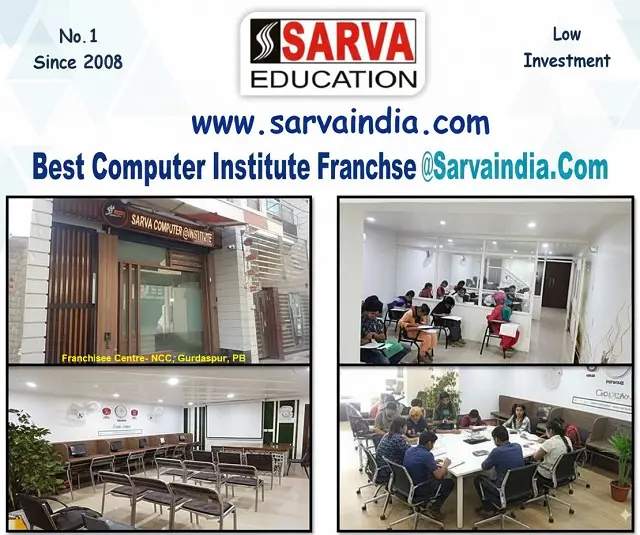
The model is designed to work without a dedicated commercial space. A spare room at home, a rented floor of a residential building, or a small high-street unit are all functional starting points. There is no mandated minimum square footage, which substantially lowers the barrier to entry — the franchisee furnishes the space with basic seating, a teaching station, and computers appropriate to the batch size.
Sarva Education supplies a centre startup kit that includes prospectus materials, student identity cards, authorisation documentation, and physical branding elements. Digital study materials are accessible through the franchisor’s platform. The franchisee’s setup responsibility is essentially the physical space and equipment; the brand assets and academic infrastructure come through the franchise agreement. This division makes the setup process straightforward for someone without prior business experience.
Ongoing Support After the Centre Opens
Beyond the first ninety days, franchisee support shifts from setup guidance to operational continuity. Sarva Education offers placement assistance for students — a practical benefit that helps with retention and word-of-mouth — along with access to updated course syllabi as industry skill requirements shift. National-level marketing keeps the brand visible in ways that a single centre owner cannot independently sustain. When an operational problem arises — a curriculum question, a certification process clarification, an administrative escalation — the franchisor’s communication channels are documented in the onboarding materials. Response speed varies depending on the complexity of the issue, but the framework for escalation exists from day one.
Who Runs a Sarva Education Centre Successfully
The franchisees who build consistently enrolled centres tend to be people who are already embedded in their local community — teachers, former educators, homemakers with an active social network, or salaried professionals who understand the neighbourhood’s aspirations for its young people. The ability to hold a genuine conversation with a parent about their child’s career options, and to follow up without it feeling transactional, matters more in the first year than any marketing tactic. The model accommodates part-time management once the centre is staffed and routines are established, making it workable for salaried professionals running it alongside existing employment.
The franchisee who consistently underestimates what the role demands is the one who expects the brand name alone to generate footfall without investing personal effort in community relationships during the first six months.
Accepting franchise applications in 35 states & UTs


How much space is required to open a Sarva Education centre?
There is no fixed minimum area requirement, and the model explicitly supports home-based operation. A room large enough to seat a small student batch comfortably — typically twelve to twenty students depending on the course format — is sufficient for initial operations. Franchisees can scale physical capacity as enrollment grows.
How long does it take to set up and open a Sarva Education franchise?
Setup complexity is rated simple, and most franchisees are operationally ready within a few weeks of completing the agreement. The primary variables are sourcing and arranging the physical space, procuring computing equipment, and completing the onboarding process with the franchisor. Centres with an existing suitable space in place have opened within two to three weeks.
What curriculum and teaching materials does Sarva Education provide?
Franchisees receive access to Sarva Education's library of e-study materials across its full course portfolio, which covers everything from basic computer literacy to specialised diplomas in digital marketing, hardware, networking, and teacher training. Physical materials including prospectuses and reference books are included in the startup kit. Course syllabi are periodically updated to reflect changes in industry skill requirements.
Can a Sarva Education centre be run without the owner being present daily?
Once the centre is staffed and batch schedules are established, day-to-day delivery can be managed by the teaching team. The franchisee's active involvement is most critical in the first three to six months — for student acquisition, teacher onboarding, and administrative process-building. After that phase, a part-time supervisory role is workable, particularly for franchisees managing the business alongside other employment.
How many Sarva Education centres are operating in India currently?
The Sarva Education franchise network falls within the range of one thousand to ten thousand active centres nationally, placing it among the larger education franchise networks in India by unit count. The brand's fifteen-year franchising history and an average of over three hundred new units added annually reflect a sustained expansion pace rather than a concentrated recent push.
Disclaimer: All scores, rankings, and estimates on ForeFind are independently produced editorial assessments using publicly available data and validated brand-submitted information. They are not verified facts, financial advice, or investment recommendations. Full Disclaimer.
