How to Find the Best Franchise to Invest in India: What Most Platforms Don’t Tell You
You have ₹15 lakh saved and are ready to invest in a food franchise. You open a franchise discovery platform, select the food category, and find more than 200 options waiting for your attention.
Some promise attractive returns. Others highlight low investment requirements or rapid expansion. A few appear prominently at the top of the page.
But which ones are actually worth considering?
There are no independent scores, no consistent performance indicators, and no reliable way to compare one opportunity against another. Some brands may have paid for prominent placement, but the distinction is not always obvious.
You can browse hundreds of franchise opportunities without getting any closer to an informed investment decision.
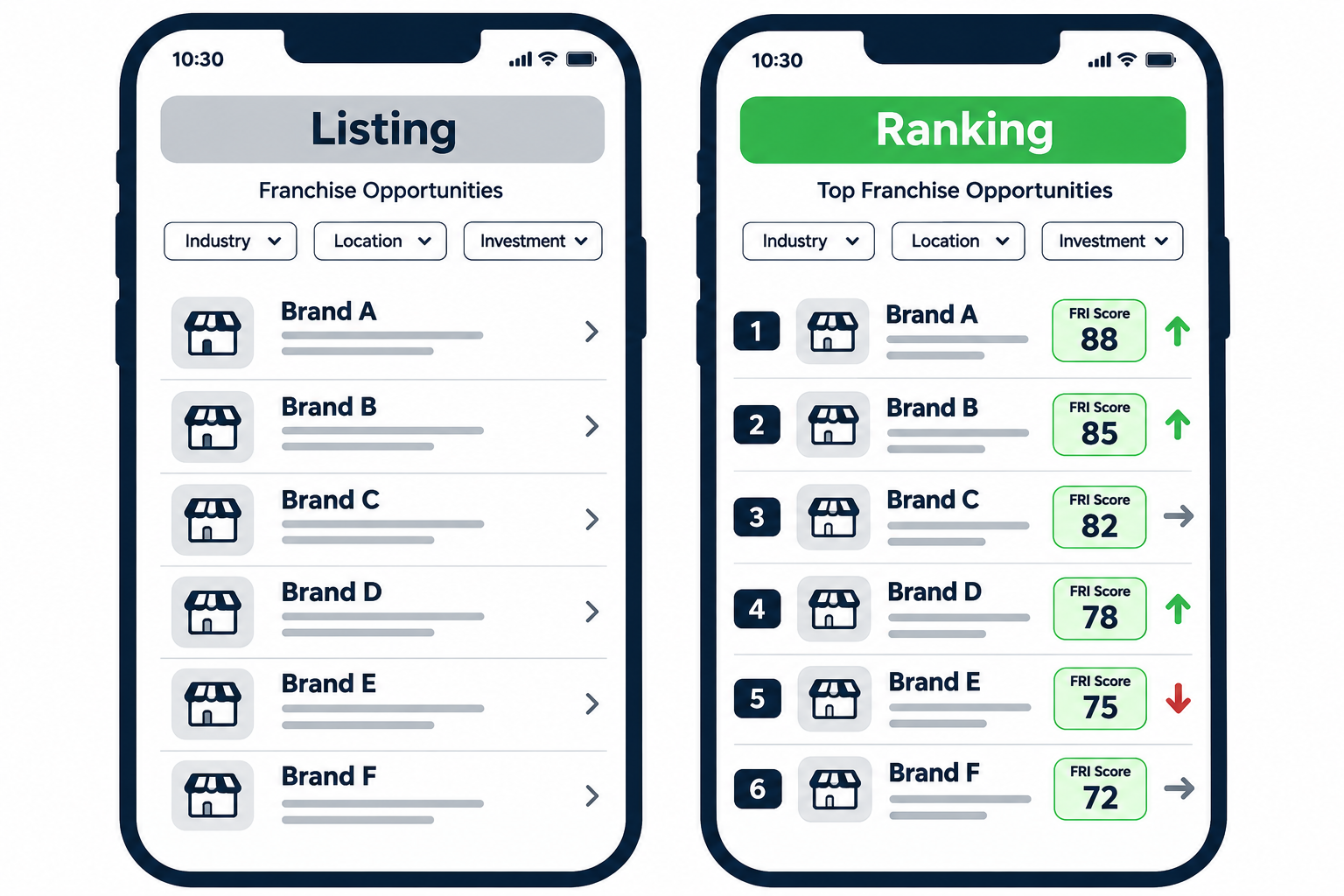
That is the fundamental problem with franchise listings. They show you what is available, not necessarily what is worth investing in.
How Franchise Platforms in India Actually Work
Most franchise discovery platforms operate primarily as listing directories. Their business model revolves around connecting franchise brands with prospective investors.
Brands create profiles containing their business descriptions, investment requirements, expansion plans, and contact information. Investors browse these profiles and submit enquiries when something catches their interest.
The platform facilitates the introduction.
Many directories generate revenue by charging brands for premium listings, featured placements, advertising packages, or lead-generation services. Depending on the platform, paying more can provide greater visibility, preferential positioning, or additional promotional exposure.
This model is not inherently dishonest. Advertising and lead generation are legitimate businesses, and paid placements can help emerging franchise brands reach potential investors.
The problem begins when commercial visibility is mistaken for investment quality.
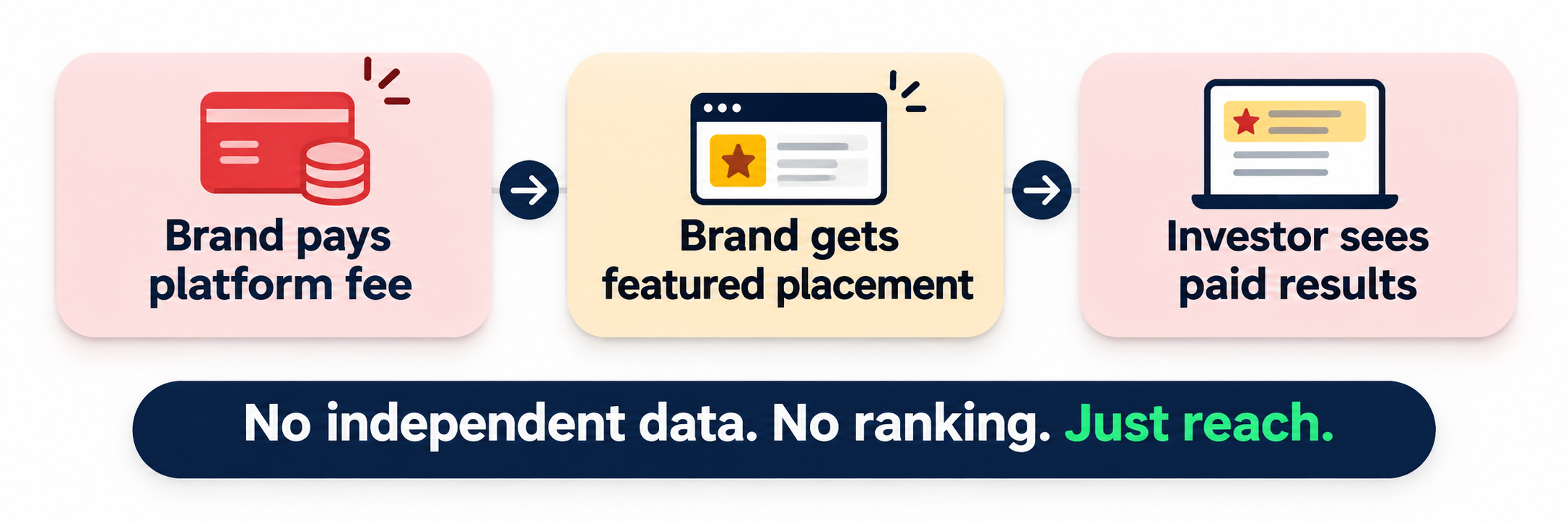
A brand appearing prominently in search results is not necessarily more financially stable, operationally mature, or capable of supporting franchise partners than one appearing several pages later.
In a standard listing model, placement may reflect advertising arrangements rather than independent evaluation. Some platforms provide useful filters and editorial information, but a directory should not automatically be treated as a quality ranking.
This creates a potential conflict between what benefits the platform commercially and what helps the investor make a sound decision.
For someone considering a substantial financial commitment, understanding that distinction matters.
A listing platform can introduce opportunities. It does not, by itself, establish whether those opportunities deserve your capital.
Why a Listing Is Not Enough Information to Invest
Consider what a typical franchise listing tells you.
You will usually find the brand name, industry category, estimated investment range, business description, expansion locations, and a form to request further information.
These details help establish whether an opportunity broadly matches your interests and budget.
But they leave several critical investment questions unanswered.
What is the average operating profit of an established franchise outlet? How many franchisees have closed their businesses? How effective is the franchisor’s training and operational support? Has the brand expanded sustainably, or has outlet growth outpaced its support infrastructure?
A conventional listing rarely provides independently verified answers to these questions.
Even when financial projections appear, investors need to distinguish between actual outlet performance, franchisor estimates, and illustrative scenarios. These are not interchangeable.
There is also the problem of comparison.
Suppose two food franchises require ₹20 lakh each. One has an established operating history and documented franchisee support systems. The other has aggressive expansion plans but limited evidence of outlet-level profitability.
A listing might present both as equally attractive opportunities because they fall within the same investment category.
Yet their risk profiles could be substantially different.
A franchise investment of ₹10 lakh to ₹50 lakh deserves more scrutiny than a brand brochure and a sales conversation.
Investors need evidence about business performance, operational capabilities, and long-term viability. They also need a consistent framework for comparing competing opportunities.
Without that framework, research becomes a collection of promotional claims rather than a structured investment assessment.
What a Data-Driven Score Actually Measures
A more useful approach is to evaluate franchise opportunities through a structured scoring framework, sometimes described as a Franchise Readiness Index.
Instead of treating every listing as an equally credible opportunity, such a framework assesses brands against consistent criteria.
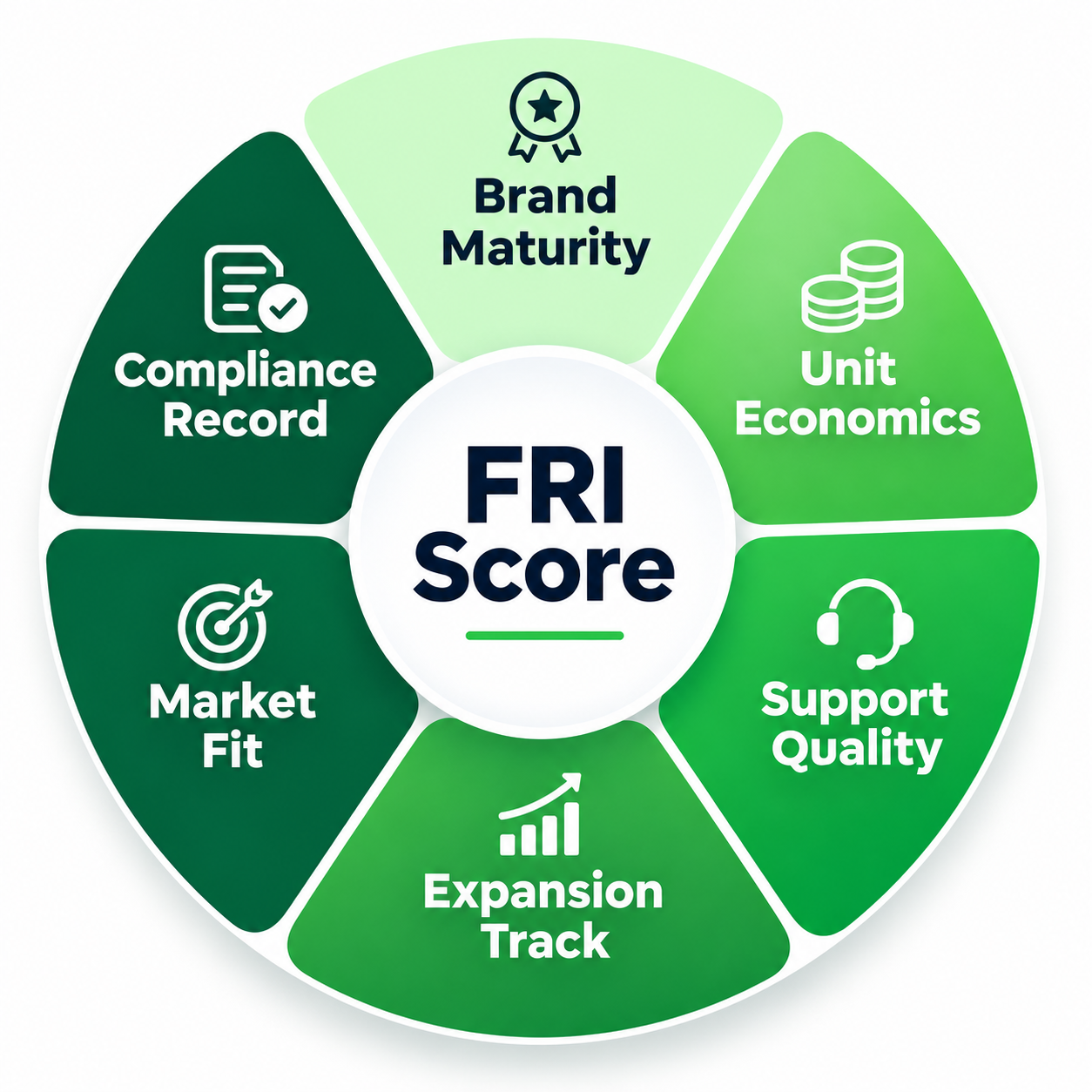
A composite franchise score could examine six important dimensions:
- Brand maturity: Operating history, business stability, management experience, and evidence of an established business model.
- Unit economics: Available evidence on investment requirements, outlet revenue, operating margins, break-even expectations, and capital recovery.
- Support infrastructure: Training systems, operational guidance, supply chain capabilities, marketing assistance, and franchisee support.
- Expansion and market fit: Outlet growth, geographic presence, local demand conditions, and suitability for different markets.
Compliance history and regulatory considerations should also form part of the assessment. Relevant indicators may include documented disputes, disclosure practices, and applicable business registrations.
The value comes from evaluating these factors together rather than relying on any single claim.
For example, rapid outlet expansion might appear positive. But if growth is accompanied by weak support systems or poor unit economics, expansion alone should not justify a strong assessment.
Equally important is how the score is calculated.
A credible scoring framework needs transparent criteria, consistent application, appropriate weighting, and clear treatment of missing or unverified information.
Independent data does not automatically mean complete data. Private franchise businesses may not disclose every financial or operational metric, and estimates should never be presented as verified results.
A score is useful because it makes comparison more systematic, not because it eliminates uncertainty.
It helps investors identify which opportunities warrant deeper investigation before committing time, money, or personal information.
How ForeFind Is Built Differently
ForeFind approaches franchise discovery through a scoring and ranking model rather than relying exclusively on conventional brand listings.
At the centre of this approach is the FRI Score, a structured assessment that uses more than 90 data points to evaluate franchise opportunities.
The scoring framework is applied to every franchise brand on the platform, creating a common basis for comparison.
This matters because investors are no longer limited to comparing promotional descriptions written by different brands. They can begin with a standardized assessment and examine how opportunities compare against the same evaluation framework.
However, a score should be treated as a research indicator, not a guarantee of profitability or franchise success. Investors still need to understand the methodology, the underlying evidence, and the limitations of available data.
Another important distinction is ForeFind’s editorial independence.
Franchise brands cannot pay to improve their rankings.
In a marketplace where paid visibility can influence which opportunities receive attention, separating commercial relationships from ranking decisions addresses a meaningful conflict of interest.
The principle is straightforward: a brand’s position should reflect its assessment against the scoring criteria, not its advertising budget.
ForeFind also operates without a franchise brokerage commission model.
The platform does not earn commissions from completed franchise deals. This removes a direct transaction-based financial incentive to encourage investors toward particular brands.
That does not make any research platform automatically unbiased. Independence still depends on transparent methodology, consistent scoring practices, and responsible handling of information.
ForeFind’s database covers 16,400+ franchises across 14 industries, 227+ subcategories, and 200+ Indian cities.
This breadth allows investors to explore opportunities beyond familiar brands or heavily advertised categories.
Its search functionality also lets investors narrow opportunities by industry, location, and investment budget, covering ranges from ₹10,000 to ₹5 crore and above.
The practical benefit is a more structured starting point: investors can first identify relevant opportunities, then compare their assessed strengths before approaching franchisors.
What This Means for Your Franchise Research Process
A scoring platform should change the order in which you research franchise opportunities.
Instead of contacting brands first and evaluating them later, begin by building a shortlist based on evidence.
Start with your available investment budget, preferred industry, and target city. Remember that your budget must account for more than the initial franchise fee. Fit-out costs, deposits, inventory, working capital, and operating reserves can materially affect affordability.
Next, use the FRI Score to identify opportunities that meet your research standards. Set a minimum score threshold as a screening tool, but do not treat it as an automatic investment approval.
Compare brands within the same category and similar investment bands. A low-cost service franchise and a capital-intensive restaurant should not be assessed as interchangeable businesses.
Where historical ranking data is available, examine whether a brand’s position has improved, declined, or remained stable. Investigate the reasons rather than assuming every movement reflects a meaningful change in business quality.
Only then begin contacting shortlisted franchisors.
Request outlet-level financial evidence, speak with existing franchisees, examine the franchise agreement, and independently validate the assumptions behind projected returns.
Use rankings to decide what deserves investigation. Use due diligence to decide what deserves investment.
Better Franchise Decisions Start With Better Questions
A franchise listing answers one basic question: which brands are looking for investors?
A credible ranking system attempts to answer a more useful one: which opportunities show stronger evidence of readiness, stability, and operational capability?
That difference matters when your investment represents years of savings, borrowed capital, or a significant career decision.
No scoring system can predict the outcome of an individual franchise investment. Location, execution, local competition, financing costs, and the quality of the franchisor relationship will still influence results.
But structured comparisons can help you avoid treating every opportunity as equally credible.
ForeFind’s franchise scores and rankings are free to browse. You do not need to create an account to view FRI Scores, and the scoring methodology is published on the platform for investors to examine.
Start your franchise research at ForeFind.com.